Father Will
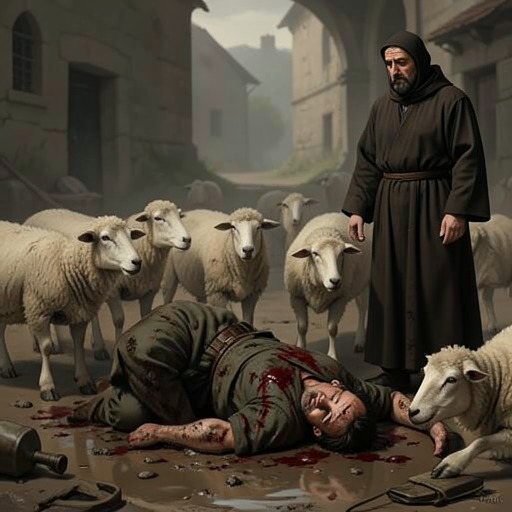
Three Bags FullFather Will is the long-nosed, black-clad priest whom George’s flock regard as one of the suspicious figures surrounding their shepherd’s death. To the sheep, his religious language, old hostility with George, and apparent interest in the flock’s future make him difficult to separate from the mystery. Their suspicion is vivid, but not proof: the clues establish a strained history and a return to the scene, not his responsibility for George’s killing.
Identity and Religious Authority
Father Will is introduced among the likely suspects as a sinister priest. At the gathering after George’s death, he describes George as a lost soul and a lamb gone astray, adding that the Lord has taken him home. His language presents death as a spiritual resolution, while his companion’s distress and uncertainty about George’s affairs give the scene a more worldly tension. The sheep hear his confident account, but it does not answer who killed George.
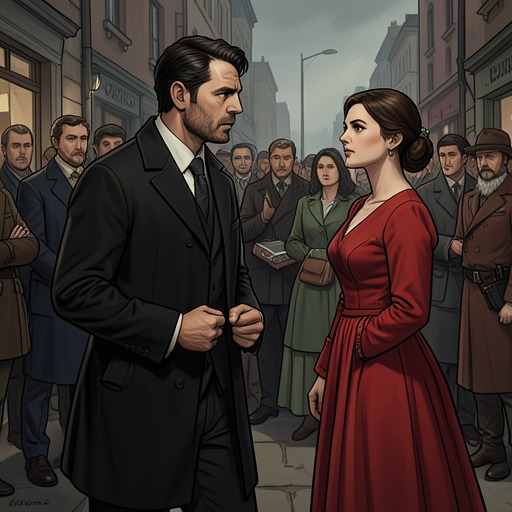
His authority is expressed less through comfort than through order. When the woman speaks of Ham, Father Will invokes care joined to rigor, the word joined to the sword, and the importance of order. He offers to approach Ham on her behalf if she feels awkward doing so herself. The offer suggests that he considers himself able to intervene, while his severe formulation makes the sheep fear what such intervention might mean. The woman refuses and says that her business with Ham is over, leaving the history between them unexplained.
An Earlier Encounter with George and Cloud
Cloud remembers Father Will from a visit to the pasture long before the investigation. She was still a lamb, held in George’s arms just after he had trimmed her hooves. In her recollection, the day’s smells turn abruptly from earth and sun to something bitter: George disliked the visitor, whose voice sounded unfriendly as he invited him to let the animals receive a blessing. Cloud did not understand the ceremony and feared that the blessing might be something done to her.
George answered with a joke at Father Will’s expense, saying that if he meant Ham, Father Will blessed him every Sunday. The priest became angry and spoke about dividing sheep from goats. The exchange shows that their antagonism predates George’s death and that religion had already become a point of conflict between them. When George grew angry, he put Cloud into Father Will’s arms and challenged him to bless the lamb. Father Will took her away, but, in Cloud’s account, did not know how to hold her properly.
He brought Cloud to his large, tall, pointed house and shut her alone in its garden. An apple tree stood there behind a fence, with fruit left to rot on the ground. For Cloud, the enclosed garden is not a place of abundance but of isolation: food is visible and wasted, while she is kept apart from the flock. The remembered episode gives concrete form to the sheep’s sense of Father Will as a man who speaks of care while imposing separation and control.
The Sheep’s Interpretation of God
Cloud’s memory also exposes how the flock tries to interpret human religion through familiar sheepish categories. After a while, she thought the people were worshipping a special lamb, which seemed to her a pleasant idea. They called it the Lord, and there was music unlike what she knew from the radio. Then she saw a wounded, unclothed man hanging on a wall. Although he appeared to be bleeding, Cloud could not smell blood; frightened, she would say no more.
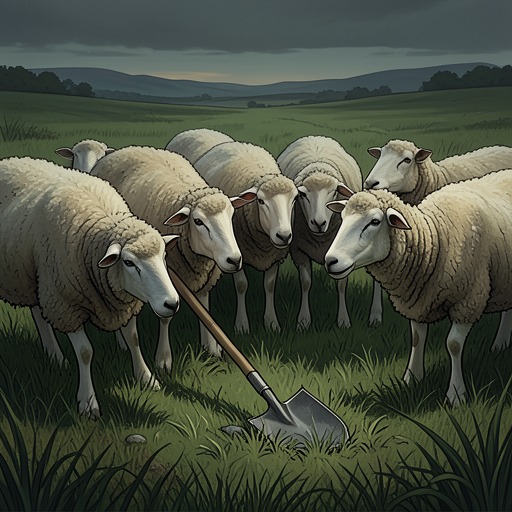
Sir Ritchfield turns this account into a question about whether the image showed a spade, and Mopple calls the religious figure suspicious. The sheep’s guesses do not amount to an explanation of Father Will’s beliefs; instead, they show how the flock’s practical senses and George’s stories shape its reading of unfamiliar human signs. Their eventual suggestion that the long-nosed visitor’s name might be God further confuses the priest with the deity he serves. That mistake is comic, but it also makes his authority seem more ominous to them: the man who once carried Cloud away is associated with a power she cannot understand.
Suspicions After George’s Death
Father Will’s conduct after George’s death adds a present-tense reason for the flock to watch him. Miss Maple notes that he seems too interested in what will happen to the sheep and the meadow. She also remembers that, while standing by the dolmen, he looked at the exact place where George had been lying. To the sheep, that specific glance joins his earlier hostility with George and his return to the place where the body was found.
Mopple connects the visit to a lesson from one of George’s detective stories: the murderer returns to the scene of the crime. Miss Maple agrees that Father Will’s behavior seems suspicious, but immediately allows that the look could have been coincidence. Her caution matters. The flock has a remembered quarrel, an unsettling visit, and a potentially meaningful glance, yet still lacks an answer to its further questions: what lay behind the old business with Ham, and whom the woman feared George might benefit in his will? Father Will therefore functions as a compelling suspect within the sheep’s inquiry, not as a conclusively identified killer. His narrative significance rests on that unresolved tension between religious certainty and evidentiary uncertainty.